Source indoor enterprise network router for offices, schools, and hotels
Find and compare 30 indoor enterprise network router options featuring diverse chipsets like Qualcomm Sdx55 and Mtk7620A. Buyers can evaluate specifications including 4G Cat 4, WiFi 6, and various port configurations to match specific business needs.
Key considerations
Products List




Comprehensive Sourcing Guide
Strategic Sourcing Guide for Indoor Enterprise Network Routers
Selecting the right indoor enterprise network router requires a rigorous approach that balances technical performance, regulatory compliance, and total cost of ownership. The market offers a diverse array of devices, ranging from compact units designed for small office deployments to robust industrial-grade routers capable of handling complex mesh topologies. For procurement professionals, the primary challenge lies in navigating the vast array of specifications to identify hardware that aligns with specific network architecture requirements without overpaying for unnecessary features or under-specifying for critical operational needs. This guide provides a structured framework for evaluating indoor enterprise routers based on verified product attributes, ensuring that sourcing decisions are grounded in factual data and industry standards.
Technical Architecture and Performance Specifications
The foundation of any reliable enterprise network lies in the router's internal architecture and transmission capabilities. When evaluating potential suppliers, buyers must scrutinize the chipset and network mode specifications, as these directly dictate throughput and stability. In the current market, high-performance indoor routers often utilize advanced chipsets such as the Qualcomm Sdx55 paired with WiFi 6 technology, which supports transmission rates exceeding 200Mbps and operates across 5G Sub-6GHz bands. This combination is essential for modern enterprises requiring low latency and high bandwidth for data-intensive applications.
Conversely, other segments of the market may rely on different architectures, such as the Mtk7620A chipset, which supports 802.11AC standards with dual-frequency operation on 2.4GHz and 5.8GHz bands. These units typically offer a transmission rate of 1200Mbps and utilize a 2x2 MIMO antenna configuration to enhance signal reliability. It is critical to distinguish between devices designed as Access Points (AP) and those functioning as Station (STA) nodes, as the "AP+STA" work mode allows for versatile deployment in mixed environments. Furthermore, the physical interface capabilities must be verified; enterprise-grade units often provide a comprehensive suite of ports including WAN, multiple LANs, RS232, RS485, USB, and GPIOs, facilitating integration with legacy industrial systems and diverse peripheral devices.
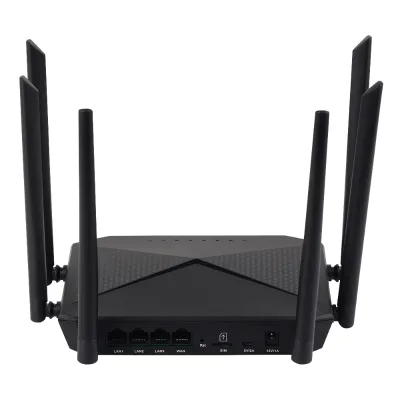
Buyers should also assess the antenna configuration, which varies significantly between models. Some units feature built-in antennas, which are ideal for aesthetically sensitive indoor environments where external protrusions are undesirable. Others, particularly those intended for broader coverage areas, may utilize external antennas with specific gain ratings, such as 5dBi, to maximize signal penetration through walls. The physical dimensions of the router are equally important for indoor installation; standard form factors range from compact units measuring approximately 160mm x 86mm x 29mm to larger chassis measuring up to 250mm x 145mm x 67.5mm. Ensuring the device fits the designated rack space or wall-mount location is a prerequisite for successful deployment.
Compliance, Certification, and Regulatory Standards
Regulatory compliance is non-negotiable for enterprise hardware, particularly when deploying equipment across different geographic regions. The primary certifications to verify are CE and RoHS, which indicate conformity with European safety, health, and environmental protection requirements. A product listing that explicitly states "CE, RoHS" or "RoHS, CE" provides a baseline assurance that the device meets fundamental electromagnetic compatibility and hazardous substance restrictions. However, procurement teams must remain vigilant, as certification status can vary between product models even within the same supplier's catalog.
Beyond general certifications, buyers should verify specific standards related to the physical construction and operational safety of the router. For instance, the physical dimensions of the unit are often listed as a standard specification, such as 93.5mm x 93.5mm x 172.5mm or 23mm x 20mm x 12cm, which serves as a reference for packaging and installation planning. It is also essential to confirm the origin of the product, as manufacturing locations can influence supply chain reliability and regulatory adherence. Products originating from established manufacturing hubs like Shenzhen, China, often benefit from mature supply chains, but this must be balanced with the specific quality control protocols of the supplier.
When evaluating compliance, buyers should also consider the operating voltage range, which is critical for ensuring compatibility with existing power infrastructure. Enterprise routers typically support a wide input voltage range, such as +6V to +48V, to accommodate various power supply units and backup battery systems. This flexibility is particularly important in environments where power stability is a concern. Additionally, the software version and operating system, such as Openwrt or Linux, should be verified to ensure long-term support and the ability to customize network configurations according to enterprise security policies.
Cost Drivers and Pricing Dynamics
Understanding the cost drivers for indoor enterprise routers is essential for budgeting and negotiating effective procurement strategies. The observed price range in the market spans from approximately $6 to $8,000, reflecting the vast disparity between basic connectivity devices and high-end, feature-rich enterprise solutions. Several factors contribute to this variance, including the chipset technology, the complexity of the network architecture, and the level of customization available.
High-performance routers equipped with advanced chipsets like the Qualcomm Sdx55 and supporting 5G Sub-6GHz networks command a premium price due to the superior transmission rates and lower latency they offer. Similarly, devices with modular port structures and crossbar system architectures, designed for intermediate node routing in large-scale enterprise networks, typically fall into the higher price brackets. In contrast, routers with non-modular structures and lower transfer rates, such as those capped at 1000Mbps, may be more cost-effective for smaller deployments.
The Minimum Order Quantity (MOQ) is another significant cost driver, with observed ranges spanning from 1 unit to 1,000 units. Buyers purchasing small quantities may face higher per-unit costs or limited customization options, whereas bulk orders often unlock volume discounts and the ability to request specific customizations, such as branding or pre-loaded software configurations. The packaging type also influences logistics costs; while standard export cartons are common, specialized packaging like air express or original boxes may incur additional fees. Procurement teams should analyze the total cost of ownership, including shipping, potential tariffs, and the cost of spare parts, rather than focusing solely on the unit price.
Typical Applications and Deployment Scenarios
Indoor enterprise network routers serve a wide variety of applications, ranging from small office environments to large-scale industrial facilities. The choice of router depends heavily on the specific network requirements of the deployment site. For instance, routers with an "Intermediate Node Router" designation and "Enterprise" application classification are ideal for complex network topologies where multiple nodes need to communicate seamlessly. These devices often feature firewall capabilities and modular port structures, allowing for flexible expansion as the network grows.
In industrial settings, routers with robust interfaces, including RS232 and RS485, are crucial for connecting to legacy machinery and sensors. The "Multi Bus Mmulti CPU" architecture found in certain models supports high reliability in environments where continuous operation is critical. These units are often designed to operate in harsh conditions, with voltage ranges that accommodate unstable power supplies. Additionally, routers with "Non Line Speed Router" performance characteristics may be suitable for applications where cost is a primary concern and maximum throughput is not the defining requirement.
For wireless-centric deployments, the distinction between AP+STA work modes is vital. Devices operating in this mode can function as both access points and client stations, enabling the creation of mesh networks that extend coverage throughout large indoor facilities. The antenna configuration, whether built-in or external, plays a significant role in determining the effective range and signal strength. Buyers should assess the physical layout of their facility to determine whether a compact, built-in antenna solution is sufficient or if external 5dBi antennas are necessary to overcome physical obstructions.
Supplier Evaluation and Quality Control
Evaluating suppliers requires a thorough review of their product documentation and quality assurance processes. Buyers should prioritize suppliers who provide clear and detailed specifications for their products, including exact model numbers like HIR300, HIR100, HDRM200, and HOR204. These identifiers help in tracking specific product versions and ensuring consistency across orders. The presence of detailed technical attributes, such as DDR memory capacity (e.g., 512m) and CPU type (e.g., Qualcomm), indicates a supplier that is transparent about their hardware capabilities.
Quality control should be a central component of the supplier selection process. Buyers must verify that the supplier adheres to strict manufacturing standards and provides evidence of consistent quality across their product lines. The packaging method, whether it is a standard export carton, original box, or air express packaging, can serve as an indicator of the supplier's attention to detail and commitment to protecting the product during transit. Additionally, the availability of customization options suggests a supplier that is willing to collaborate with buyers to meet specific requirements, which is a positive sign of a responsive and customer-focused partner.
When assessing quality, buyers should also consider the software support provided. Routers running on Openwrt or Linux platforms offer greater flexibility for customization and security updates. Ensuring that the supplier provides ongoing support for these operating systems is critical for maintaining network security and performance over the long term. Furthermore, the supplier's ability to provide test results and performance data, while not always explicitly listed in initial product descriptions, should be a point of discussion during the negotiation phase to validate the claimed specifications.
Long-Term Procurement Considerations
Sourcing indoor enterprise network routers is not merely a transactional activity but a strategic decision that impacts the organization's network infrastructure for years to come. Long-term considerations include the availability of spare parts, the lifespan of the hardware, and the supplier's ability to provide firmware updates and technical support. Buyers should prioritize suppliers who demonstrate a commitment to product longevity and offer clear roadmaps for future upgrades.
The modularity of the router's port structure is another key factor for long-term scalability. Modular routers allow for the addition of new interfaces as network requirements evolve, whereas non-modular units may require complete replacement when new connectivity needs arise. Similarly, the ability to customize the device, such as pre-installing specific software configurations or branding, can streamline deployment and reduce operational overhead.
Finally, buyers should establish a clear communication channel with the supplier regarding lead times and inventory management. While specific lead times may vary, understanding the supplier's production capacity and their ability to meet demand during peak periods is essential for maintaining business continuity. By focusing on these long-term factors, organizations can ensure that their network infrastructure remains robust, secure, and adaptable to future technological advancements.
FAQs
What certifications do indoor enterprise network routers typically have?
Most units listed carry CE and RoHS certifications, ensuring compliance with European safety and environmental standards. Buyers should verify these marks on specific models like HIR300 or HDRM200 before deployment to guarantee regulatory adherence in target regions.
Which chipsets are available for high-performance indoor routers?
Advanced models utilize the Qualcomm Sdx55 paired with WiFi 6, while others feature the Mtk7620A chipset. These processors support transmission rates exceeding 200Mbps and enable dual-frequency operation for stable enterprise connectivity in diverse network environments.
Can I find routers with customizable features for my network?
Yes, customization is available for many indoor enterprise network router models. Suppliers offer options to tailor hardware and software configurations, allowing buyers to adapt devices like the HIR100 to specific operational requirements without compromising core functionality.
What is the typical voltage range for these industrial routers?
Devices generally support a wide input voltage range from +6V to +48V. This flexibility ensures compatibility with various power supply units and backup systems, making them suitable for environments with unstable power infrastructure or diverse electrical standards.
How do antenna types affect indoor router performance?
Antennas vary between built-in and external types, with some offering 5dBi gain for better signal penetration. Built-in options suit aesthetic needs, while external antennas enhance coverage in larger spaces, depending on the specific model architecture and deployment scenario.
What are the standard packaging methods for these products?
Packaging options include normal export cartons, original boxes, and air express containers depending on the model. These methods protect the device during transit, with dimensions varying from compact units to larger chassis to fit different logistics requirements.